Friday, June 29, 2007

Saving America's Symbols: The Bison

I said I was going to write it, so here it is.Thanks to my fancy new newsreel, I learned of the release of a new book about the beginning of the conservation effort for the American Bison, back in Teddy Roosevelt's day, and it reminded me that I had planned to write this article.
Like the American Mustang, the Bison or Buffalo can be considered one of the founding creatures of our Nation. The constant migration of massive herds of Buffalo, and by massive I mean 30 million of the beasts, kept our great plains open and grassy, thwarting the encroachment of brush and trees. Entire cultures existed because of the Buffalo, Native Americans following the herds, hunting for what meat and hides they needed, and revering the Buffalo as they should, as a giver of life. Then, in the early-mid 1800's American settlers and trophy hunters from Europe began moving further west from the Mississippi. Buffalo were coveted for their hides and tongues, maybe their liver. The rest was left to rot. As the wholesale slaughter of Buffalo continued throughout that century (in the early days the herds were so thick you could shoot animals from a passing train) cultures and ecosystems began to suffer. Wolves, bears and mountain lions, while also coveted for their hides were also seen as competition for the elk and buffalo, and slaughtered. As more people came west and more of their life giving buffalo were taken, the great plains tribes came in to further and further conflict with settlers. By the turn of the century there were reportedly less than 30 buffalo left in Yellowstone National Park. Thats one MILLIONTH the number the great plains originally supported.
Today the American Bison continues to live under seige. While the Yellowstone population is up to a healthy 4000 animals, and South Dakota's Custer State Park holds 1,500, some of these buffalo are virtual prisoners in their supposed sanctuary. By nature the buffalo is a wanderer. This is how 30 million of them could be sustained by our American prairies. They are constantly moving to new grazing, rarely overgrazing an area. However, in Yellowstone National Park they can be rounded up and/or shot if they wander outside the park's three and a half thousand square miles. Speculation that the buffalo carry cattle diseases has ranchers in the northwest states up in arms and prepared to shoot the beasts on sight. My first response to this would be: "Don't you vaccinate your cows, man?" Furthermore, studies have shown that elk also carry the diseases, and elk are not restricted. No case of a buffalo transmitting the disease to cattle has ever been cited, and buffalo seem to naturally prefer not to mingle much with cattle. To me it seems like these animals are not 'living free' within our National Parks, but are being contained as a tourist attraction in a no-touch visual petting zoo. Animals of such dignity deserve better treatment than that.
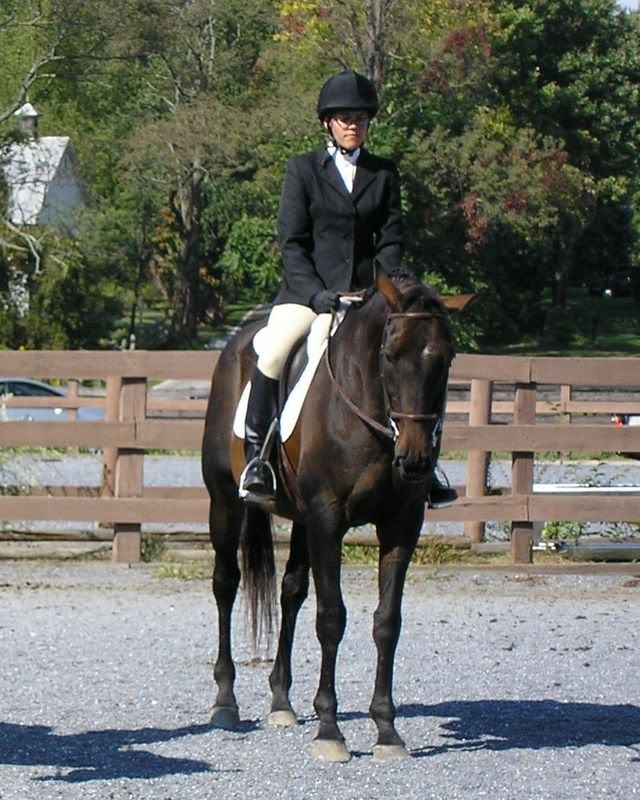
I shall now descend from my high-horse (Really, he's 16.1!) and leave you with some links to information on buffalo and how you can help save them once again from the thoughtless and selfish actions of mankind. (So glad I'm a woman!)

Defenders Bison Page: Send letters to Congressmen urging them to stop the hazing, containment and slaughter of buffalo.

Thursday, June 28, 2007

Houston, we have a widget!

Just wanted to stop by for a moment and tell everyone to check out my new newsreel on the right sidebar there. I may need to tweak my keywords in order to get the most relevant articles possible, but for now it looks pretty good!
No further updates at this time, Firefox is having severe mental problems. Proof that even having Broadband does not make my life with computers any easier.

Monday, June 18, 2007

Same old, Same new, and sustainable fishing

Let me be honest. I get really tired of trying to plug the same stories every time Defenders or WWF, or NWF or some other charity that I get regular publications from sends me a new alert. It is encouraging to see the results in their newsletters. So many actions were taken to stop aerial gunning in Alaska, so many people attended a rally in Washington, D.C., such a law was passed to protect endangered wildlife. These are truly remarkable things that every day people like you and me CAN and DO help happen. But we never seem to quite do enough. We're constantly fighting the same battles, gaining ground, losing ground, but even when remarkable things happen we seem to never win. A new species is discovered today, and tomorrow its habitat might be threatened by off-shore drilling, or expanding agriculture. How do we find balance? Where do we draw the line between saving wildlife and saving people?
My current pet beef (moo) is about sustainable fisheries...both what it means to our oceans and our planet, and what it means to people like us. Well, maybe not exactly like us, because last I checked I wasn't a starving Angola. Also as I write this I'm eating a tuna sandwich and realizing belatedly that I have no idea if the tuna I'm eating was caught in an ethical and sustainable manner. But I digress.
In the Mediterranean Bluefin Tuna have been so overfished that the population is in danger of collapsing completely. First and foremost that means there'll be no more tuna. But what else does it mean, and what problems has it caused along the line? Consider that fifty years and more ago Giant Bluefin were harvested by countless small fishing companies along the shores of the Mediterranean. Today only a handful of those fisheries survive, one of the most magnificent existing only as a tourist attraction...they make one big tuna gather a year and make a big show of it...they can't afford to fish more than that. Instead the unsustainable number of tuna caught in the Med is caught mostly by huge corporations with fleets of purse seiners and spotter aircraft. While people are appalled by the idea of land animals being hunted and shot from planes, they either don't know or don't care that the same is done to our oceanic equivalent to the buffalo. Not only that, but many of these fleets are owned by companies in landlocked portions of Europe, fish are exported, and the money to be made in the catching goes with them. Not only in the Med, but all around the world this is the way in which small fishing communities die.
And not just communities, but people themselves. Off the coast of West Africa poorly managed fleets are wiping the ocean clean in order to export highly sought after species to Europe, while sustenance fisherman are left with empty hooks. Edible by-catch is thrown back into the ocean as useless and only the best stocks are saved for export, meanwhile hungry people in the marketplaces can only afford to purchase the post-filleting head, tail and bones of fish to supplement their protein poor diets.
Fish are slaughtered before they reach full size and sexual maturity, which is not only wasteful in that we've destroyed something for less than it was worth, but also means that these fish do not reproduce before they're killed, which leaves a gap in the cycle of life.
The oceans are suffering, and people are suffering. What more needs to happen before people will take action?
Read more about overfishing in National Geographic Online, and visit the WWF and Defenders webpages to make a donation or just find a list of companies that sell only dolphin-safe and sustainably caught fish.

Thursday, May 31, 2007

To kill, or not to kill: The Giant Squid

To scientists the answer to this question would likely be: kill! Kill with all speed, chop up into itty bitty pieces and cure in formaldehyde!
Recently, for the first time, Japanese scientist captured a live mature (mostly?) giant squid. This was the first time anyone had even caught one on film in the wild. Previously everything we knew about giant squid had been learned by studying their carcasses which wash up on shore or get caught in fishing nets and lines. Now for the first time we have photographs, graciously provided for all by National Geographic.
Scientists used bags of pulped shrimp and smaller species of squid as bait on large multi-pronged hooks to capture the beastie. You can see one of the hooks in the photograph of the squid's severed tentacle. Not a very nice 'howdy do'. The Squid tore the tentacle off when it struggled and made its escape. Lucky little devil fish. Call me a cynic if you will, but I just can't imagine scientists hauling a 25 foot long (that's roughly half the size we KNOW a giant squid can grow to, though its perfectly possible they get larger) species of squid that science has never studied up close before all the way up from the blackest depths of the ocean and then just letting it go. It would have probably ended up like this little beauty from the Philippines. Only in a rather larger jar. "Over 100 samples of rare species." If they're so gawdawful rare, perhaps it'd be best not to disturb them so much?
Now I'm not implying that the giant squid is a rare species, far from it. But that shouldn't be any reason to treat one like we can just go down to the store and pick one up, right?

This one reminds me of Cthulhu, encased in a block of ice, awaiting the day when he can wreak his vengeance upon the world, muahhahahaha. Ahem. Pardon me.

(Author's note: This is an old entry that somehow missed getting posted...since then I've become aware that sources are inconsistent in describing exactly what happened to the unfortunate squid. Some say he escaped, sans one tentacle, while others claim that he was hauled aboard and dissected. Personally, I'd like to believe NG when they say he escaped!)

Thursday, May 17, 2007

Get out, clean up, enjoy the day!

Alas! If only I wasn't one of those people who works 7 days a week, I would love to spend my weekend helping other volunteers and Defenders of Wildlife clean up Big Meadows at Shenandoah National Park. The Big Meadows area of the park is home to hundreds of species of rare plant life. Plant life which is integral to the continued survival of many species of birds and other animals. Invasive species (non-native, highly adaptable plant life) such as Garlic Mustard and Oriental Bittersweet are choking out the native plants this ecosystem depends on, but Defenders and the National Park service have teamed up to help repair the damage, and they need volunteers to help with the dirty work!
Now come on, I know you all love the dirty work. Me, I spent all last week tirelessly weeding my herb garden and I have the ant bites and poison ivy to show for it! That said, if you live in the Shenandoah Natl. Park area and want to volunteer, I'd advise wearing long pants and substantial work gloves!
Clean up is this Saturday and Sunday (May 19th and 20th) at Big Meadows swamp in Shenandoah Natl. Park, Luray, VA. Volunteering includes orientation and a history lesson about the park, snacks and beverages, and all your weeding tools will be supplied. So instead of just cruising along Skyline Drive this weekend, why not jump in and get your hands dirty, helping to keep our favorite ('our' being us people from Maryland, Virginia, West Virginia and Tennessee!) National Park happy and healthy!
For more information visit Defenders online and fill out their survey.

Tuesday, May 8, 2007

A portrait for conservation: Tiger Mosaic

(Note from the Author: Apologies, once again blogger refuses to publish pictures.)
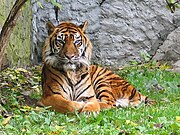
The tiger is the planet's largest feline. Individuals can weigh anywhere from 400 to 700+ pounds, depending on age, gender, and subspecies. Their distinctive striped coat pattern is as unique to an individual cat as a humans fingerprint. One of the most revered and reviled of predatory creatures in the world, it is no wonder that they are coveted by lover and loather alike.
Although tigers are listed as "Endangered" and bans on the sale of tiger skins and parts have been in place for years the biggest threat to the world's dwindling populations of Sumatran, Siberian, Bengal, Malayan, Indochinese, and South China tigers (the most critically endangered subspecies) is still poaching. Several subspecies of tiger have already been hunted to extinction.
Fortunately for tigers, they breed well in captivity. In fact, they breed so well in captivity that there are more CAPTIVE tigers than wild tigers. Unfortunately for tigers this has caused a problem...In china tigers are bred on 'tiger farms' as a sort of tourist attraction, but with the hope that someday the government will lift the ban on tiger trade and allow them to sell parts from captive tigers. At first glance this might not seem a bad idea. After all, the alligator shoe and belt trade helped save the American Alligator through captive breeding on alligator farms. Other fur and leather bearing animals are bred on farms, helping to preserve their wild populations. The problem is that the tiger's habitat has become so constricted in some places and it's population so fragile that it cannot at this point sustain itself without human intervention. And ANY lift of the ban on tiger trade would create an opening for poachers to sneak illegal tiger parts and pelts into the market. Poaching would increase, and the delicate balance of nature would be lost.
The World Wildlife Fund has come up with a wonderful and unique way for us to tell China that we oppose any lift of the ban on tiger trade. By uploading your photo to their website you can be included in the world's largest tiger photo mosaic, to be presented at the Convention on International Trade in Endangered Species. They can even show you exactly where you are in the tiger! The deadline for uploading photos is May 21 so that the mosaic can be presented at the convention in June.
Last year the Dalai Lama preached against using, selling or buying wild animals, their pelts or derivatives. Thousands of Tibetans responded by burning, tearing, or throwing away tiger and leopard hides used as rugs and decorations. Only time will tell if this sentiment will spread. Will you help?


Wednesday, May 2, 2007

Keep Wolves in Yellowstone!


Hi,
I just took action to stop one of the worst wolf massacres in decades -- and I hope you will, too.
It's easy to help. Just go to the website below to take action:
http://action.defenders.org/northernrockieswolves
The U.S. Fish and Wildlife Service has proposed to strip wolves of crucial Endangered Species Act protections in the Northern Rockies. Such a plan would allow Wyoming and Idaho to move forward with plans to eliminate as many wolves as possible within their borders.
Please help me save these magnificent animals. Tell the federal government to maintain federal protections for gray wolves by sending a message at the website below:
http://action.defenders.org/northernrockieswolves Help generate 200,000 comments to federal officials -- take action at the website above, then forward this message on to others who care about wildlife.
These wolves are in trouble. But, together, I know we can save them. I hope you'll help...
Thanks!

There, Defenders said to send it to five friends, hopefully I have reached at least that many people through this blog.
To be perfectly honest, and I love wolves, but I'm begining to feel like I'm beating a dead horse with this issue. For some reason beyond my ken wolves are one of the most revered, and most hated animals in the animal kingdom. There are people who would die to keep them, and people who would kill to be rid of them. Even if you aren't a wolf fanatic, most sane people will admit that wolves have their place in our world, just like every thing else nature has molded. Literally hundreds of thousands of people have already poured their heart and soul into pleading with officials to save wolves, be it in Idaho, Wyoming, New Mexico, or Alaska. How can anyone else take what they love away from them?
Wolves are killers. They are predators of the most elite variety. Cunning. Bold. Ruthless.
But they are also animals who love and respect one another. Caring. Nuturing. Family.
Truth be told, wolves are a lot like us.
Someone said once (and of course I can't remember who) "Wolves are people too."
There you have it.
Wolves are people too.